Global universal banks
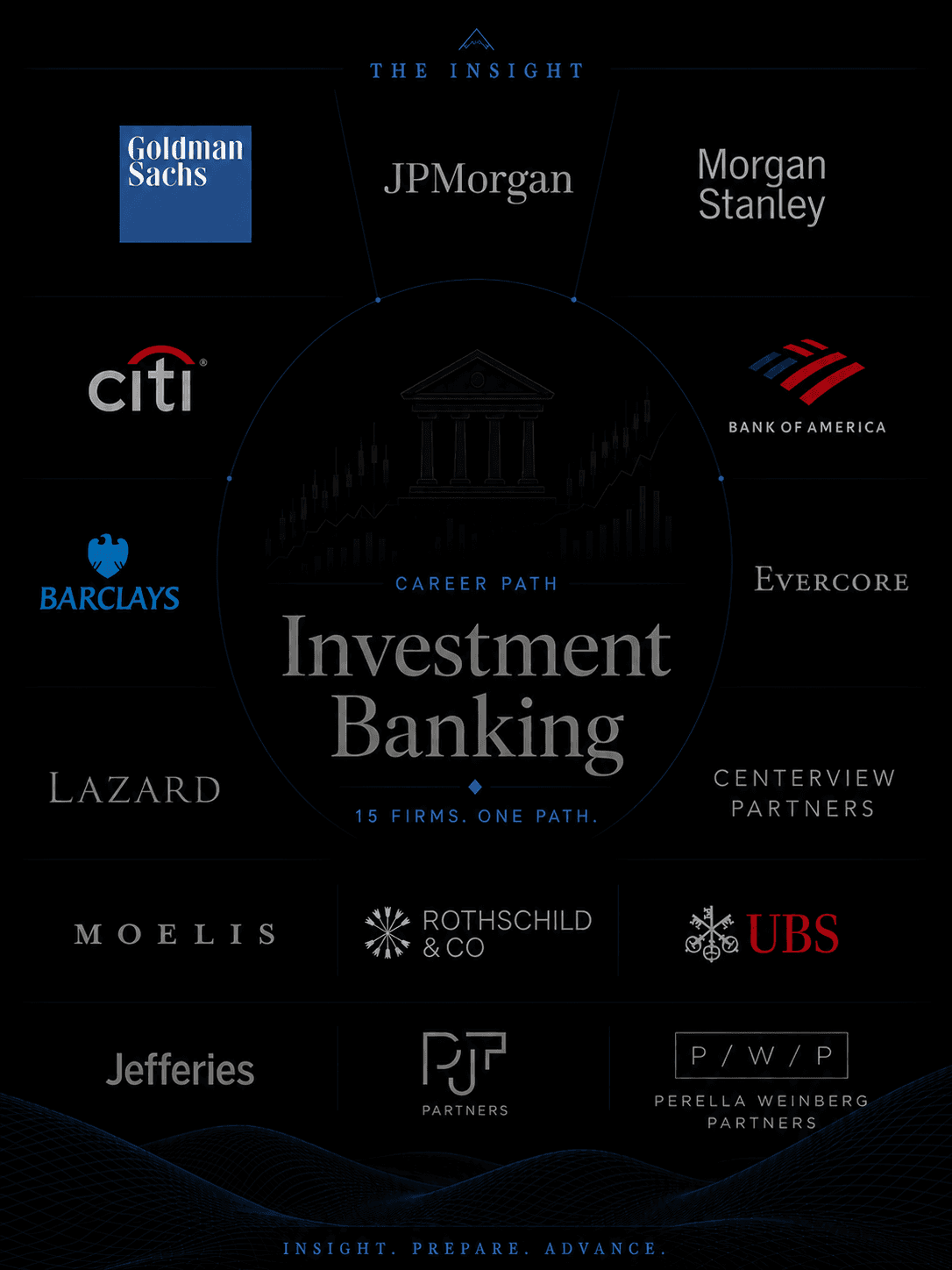
Goldman Sachs · J.P. Morgan · Morgan Stanley · Bank of AmericaLarge, multi-product platforms with broad corporate and institutional client coverage.
The Insight is preparing this page.
The Insight career field brief · Finance
A high-intensity pathway built around deals, modeling, transaction execution, and steep early-career optionality.
Markets and finance · High intensity · Detail-heavy
Investment banking is one of the most prestige-loaded paths students consider. That makes it especially important to separate the label from the labor. The job is not just finance in the abstract. It is execution-heavy, detail-intensive, and demanding.
Use this short studio to turn curiosity about Investment Banking into evidence about your own working preferences.
Select as many as feel true. There is no score to chase.
Choose a signal to start your reflection.
A simplified look at the sequence behind transaction work: learn the company, test the numbers, communicate the story and keep the process moving.
Understand the company, its market, the transaction rationale and the questions that matter most.
Open a guide to understand how experienced voices connect Investment Banking to real institutions, choices and working lives.
Build a small body of evidence about the underlying work before deciding that a firm name or deal headline is enough.
Use the landscape to ask where the work is done and what type of execution you want to learn.
Large, multi-product platforms with broad corporate and institutional client coverage.
Advisory-led firms with distinct sector, geography and transaction mixes.
Different scales and strengths across advisory, capital markets and sector expertise.
Banking concentrates on transactions, financial analysis and execution; consulting concentrates on broader client decisions.
Banking applies finance to an immediate transaction; economics studies incentives and systems more broadly.
Banking is transaction and client-process led; quant finance is model and research led.
A focused route through the tools, courses, books, data and simulations that help students understand the work—not just the title.
Microsoft · Excel Visualisation
Tutorial for Excel Visualisation.
Why it’s hereOfficial foundation for turning analysis into clear visual output.
Microsoft · PowerPoint Foundations
Tutorial for PowerPoint Foundations.
Why it’s hereA concise starting point for slide structure, text and visuals.
Microsoft · PowerPoint Foundations
Guide for PowerPoint Foundations.
Why it’s hereStep-by-step guide for new users before professional slide design.
Microsoft · Excel Foundations
Tutorial for Excel Foundations.
Why it’s hereClear first lesson on entering, formatting, calculating and charting data.
Microsoft · Excel Formulas
Tutorial + practice workbook for Excel Formulas.
Why it’s hereOfficial explanation of functions, references, operators and constants.
U.S. Securities and Exchange Commission · Financial Statements
Guide for Financial Statements.
Why it’s hereAuthoritative introduction to balance sheets, income statements and cash flow.
Microsoft · Excel Formulas
Reference for Excel Formulas.
Why it’s hereA long-term searchable reference for functions used across analytical work.
U.S. Securities and Exchange Commission · Company Research
Database for Company Research.
Why it’s herePrimary-source filings for company research and financial analysis.
Federal Reserve Bank of St. Louis · Economic Data
Tutorials + documentation for Economic Data.
Why it’s hereExplains series search, transformations, graphs and downloads.
Listen first, then use the guide and materials to turn passive interest into a practical next step.
Jonathan Garrison traces an international career spanning study in China, industrial operations, Goldman Sachs, Wanda's global expansion, advisory work, and entrepreneurship. He explains how students can use early opportunities, relationships, technical fluency, and thoughtful risk-taking to build careers with real optionality.
If you want to become more well read, start with the resources page for structured preparation materials, then work through the related articles below.
Students frequently compare professions through labels, selectivity, and reputation before understanding the labor itself.
Internships do not merely signal ambition to employers. They also help students discover whether the communication load, time structure, and incentives of a field actually fit them.
Academic rigor matters, but many schools still provide surprisingly weak informational infrastructure around careers. Students are often left to make major decisions with shallow context.